
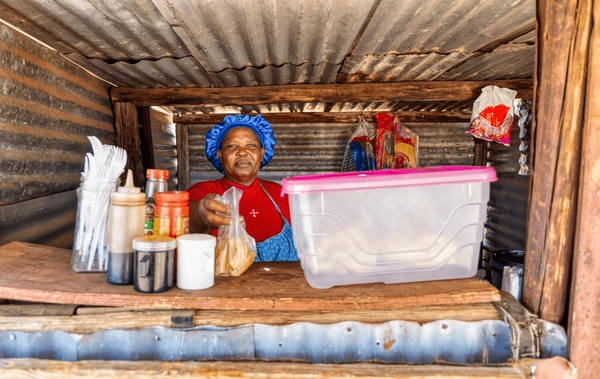
Entrepreneurship: Women in informal markets
Women across Cameroon seem to play a central role in the informal economy through small-scale trading, food vending, tailoring, and agricultural activities. In major urban markets such as Mfoundi in Yaounde, as well as in neighborhood trading points and rural communities, women-led micro-enterprises remain a key source of daily income for millions of households. These activities, though often operating outside formal registration systems, contribute to local economic circulation and household survival.
According to the International Labour Organization, informal employment remains the dominant form of work in many developing economies, particularly in Africa, where a large share of women are engaged in vulnerable and low-income jobs. The institution notes that women are disproportionately represented in informal employment, especially in trade, agriculture, and personal services. Similarly, the World Bank highlights that informal micro-enterprises remain a major source of livelihood for women in low-income settings, largely due to limited access to formal jobs, credit systems, and structured employment opportunities. The UN Women also observes that informal work often serves as the primary entry point for women into the labour market.
In Yaounde’s Mfoundi Market, one of the country’s largest commercial hubs, women traders dominate the sale of foodstuffs, vegetables, spices, and household goods. Many of these traders began with very small capital and gradually expanded their activities through daily reinvestment of profits. Ndjomo, a 38-year-old trader in the market explains that her business started with a small basket of tomatoes. “I began by selling what I could afford every morning. Today, this stall pays my children’s school fees and feeds my household,” she says. Despite unstable prices and competition, she confesses to Nicescoop that the market is her only consistent source of income.
In urban residential areas of Yaounde, women also seem to be « heavily“ involved in street food vending. Tiana is one of them. She’s used to operating in one of these neighborhoods. She prepares local dishes daily, serving customers during peak hours, particularly at midday. « Even when profits are small, I cannot stop. This is what helps me take care of my family every day, » she explains. These micro-businesses provide affordable meals for workers, students, and low-income residents.
Different area, same life
In rural parts of the Centre Region, women’s involvement in small-scale agriculture further illustrates their role in the informal economy. Female farmers cultivate crops such as vegetables and cassava, supplying both local markets and roadside buyers. Their production is often seasonal and dependent on weather conditions, but it remains essential for household food security and supplementary income. However, constraints such as limited access to farming inputs, transport, and storage continue to affect productivity and market access.
Across these different settings, a pattern emerges. One where women’s informal economic activities are closely tied to household survival. Income generated from small businesses is frequently directed toward essential needs such as education, healthcare, and daily consumption. While these enterprises operate outside formal systems, they form an important part of Cameroon’s local economic structure, ensuring continuity in household income flows and supporting community-level trade.