
Cameroon – Russia: WWII at the centre of discussions
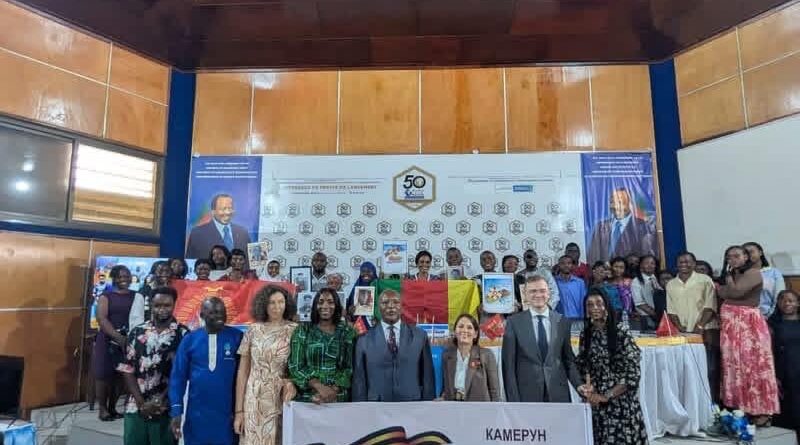
As part of the celebrations of Victory Day in Russia, the Advanced School of Mass Communication (ASMAC) hosted a conference on May 8, 2026 in Yaounde. The event focused on the memory of the Second World War. Diplomats, academics, students, and researchers gathered at the Hervé Bourges Amphitheatre to discuss the challenges related to transmitting history to future generations.
The conference was organized by the Association of Teachers of Russian Language and Literature in Cameroon under the patronage of Professor François Marc Modzom, Director of ASMAC. The meeting brought together lecturers, diplomats, researchers, students, and online participants for discussions on the historical importance of the Soviet Union’s contribution to the defeat of Nazism and the relevance of preserving historical memory for future generations.
Held under the theme “Preserving the Collective Memory of the Second World War,” the conference began at 11 a.m. and served as a platform for intellectual and historical reflection. Speakers included Mrs. Olga Gogolina, Professor Michèle Mekeme Ngoyone, Mr. Alexandre Morozov, Dr. Ngan Tonye François Pierre, Mrs. Tatiana Tudevseva, and other contributors who addressed different dimensions of the war and its global consequences.
During the discussions, participants recalled that the Soviet Union played a role in the Allied victory against Nazi Germany during what Russians call the Great Patriotic War (1941–1945). The speakers revisited major historical events such as Operation Barbarossa in 1941, the battles of Moscow, Stalingrad, and Kursk, as well as Operation Bagration in 1944, which contributed to the liberation of Eastern Europe and the eventual fall of Berlin. They also emphasized the “heavy“ human cost of the war, noting that more than 27 million Soviet citizens lost their lives.
History falsification of Cameroon during the War
Highlighting the importance of protecting historical truth, the conference had as objective to transmitting the memory of the war to younger generations. Several speakers warned against attempts to distort or rewrite history and insisted on the duty of remembrance as a universal responsibility. In this context, reference was made to the “Immortal Regiment” tradition in Russia, where descendants march with photographs of relatives who fought during the war in order to honor their sacrifices.
Beyond Europe, speakers also highlighted the indirect impact of the Second World War on Cameroon and several African countries. At the time still under French and British colonial administration, Cameroon saw many of its citizens recruited as soldiers and laborers to support the Allied war effort. Historians at the conference noted that the war accelerated political consciousness across Africa, as returning African veterans began questioning colonial domination after fighting for freedom abroad. The post-war period equally opened the door to stronger nationalist movements that would later contribute to Cameroon’s independence in 1960. According to the speakers, understanding the global consequences of the war also means recognizing how Africa in general and Cameroon in particular, though often absent from mainstream narratives, was deeply affected by the conflict and its aftermath.